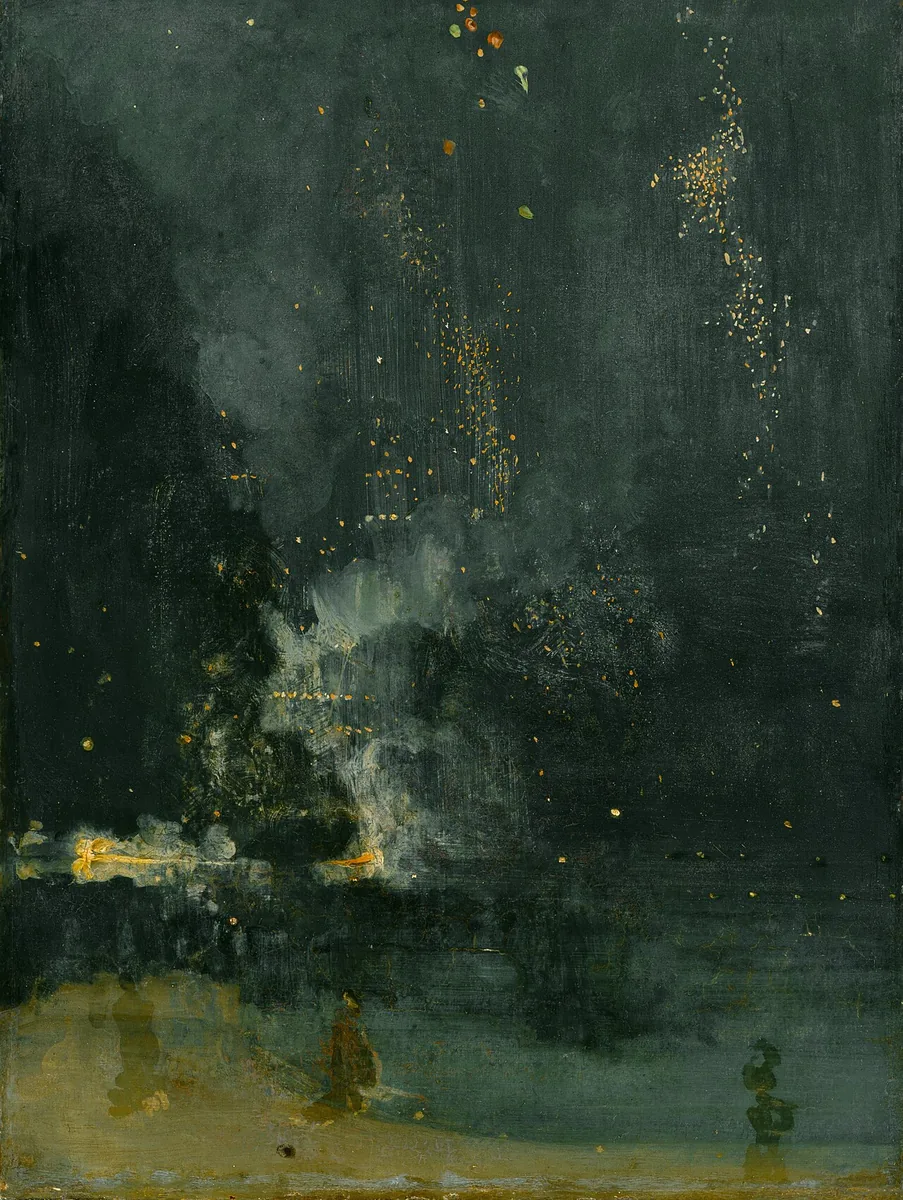
Nocturne in Black and Gold – The Falling Rocket
Match for you
Rate 5 more paintings to see how well this one matches your taste.
Where to see it
Detroit Institute of Arts, Detroit
About the painting
Nocturne in Black and Gold – The Falling Rocket is a c. 1875 painting by James McNeill Whistler held in the Detroit Institute of Arts. The painting exemplified the art for art's sake movement – a concept formulated by Pierre Jules Théophile Gautier and Charles Baudelaire.
Read more
First shown at the Grosvenor Gallery in London in 1877, it is one of two works (the other being Nocturne in Black and Gold – The Firewheel) inspired by the Cremorne Gardens, a celebrated pleasure resort in London. One of his many works from his series of Nocturnes, it is the last of the London Nocturnes and is now widely acknowledged to be the high point of Whistler's middle period. Whistler's depiction of the industrial city park in The Falling Rocket includes a fireworks display in the foggy night sky. Nocturne in Black and Gold – The Falling Rocket is most famously known as the painting behind the lawsuit brought by Whistler against the art critic John Ruskin.
The painting was featured in the 1980 BBC Two series 100 Great Paintings.
Source: Wikipedia · CC BY-SA 4.0
Similar works







Image: James McNeill Whistler; Wikimedia Commons · public domain