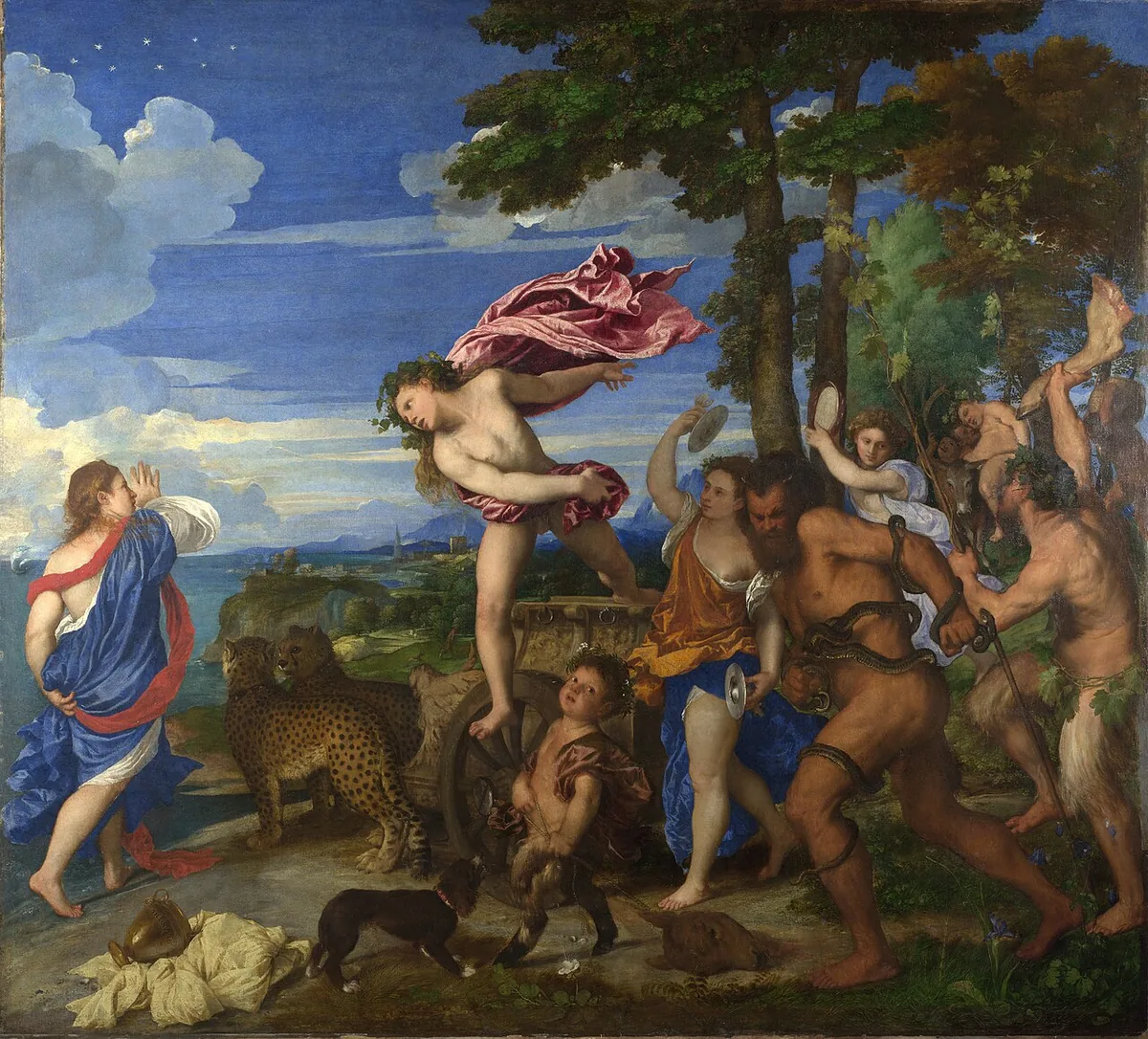
Bacchus and Ariadne
Match for you
Rate 5 more paintings to see how well this one matches your taste.
Where to see it
National Gallery, London
About the painting
Bacchus and Ariadne (1520–1523) is an oil painting by Titian. It is one of a cycle of paintings on mythological subjects produced for Alfonso I d'Este, Duke of Ferrara, for the Camerino d'Alabastro – a private room in his palazzo in Ferrara decorated with paintings based on classical texts. An advance payment was given to Raphael, who originally held the commission for the subject of a Triumph of Bacchus.
Read more
At the time of Raphael's death in 1520, only a preliminary drawing was completed. The commission was then handed to Titian. In the case of Bacchus and Ariadne, the subject matter was derived from the Roman poets Catullus and Ovid, and perhaps other classical authors.
The painting, considered one of Titian's greatest works, is now in the National Gallery, London. The other major paintings in the cycle are The Feast of the Gods, mostly by Giovanni Bellini, now in the National Gallery of Art, Washington, D.C, and Titian's The Bacchanal of the Andrians and The Worship of Venus, both now in the Museo del Prado, Madrid. The series was a very early treatment of subjects from classical mythology on a heroic scale in painting, rather than in small decorative pieces, and very influential on later works.
Source: Wikipedia · CC BY-SA 4.0
Similar works

Image: Titian; Wikimedia Commons · public domain