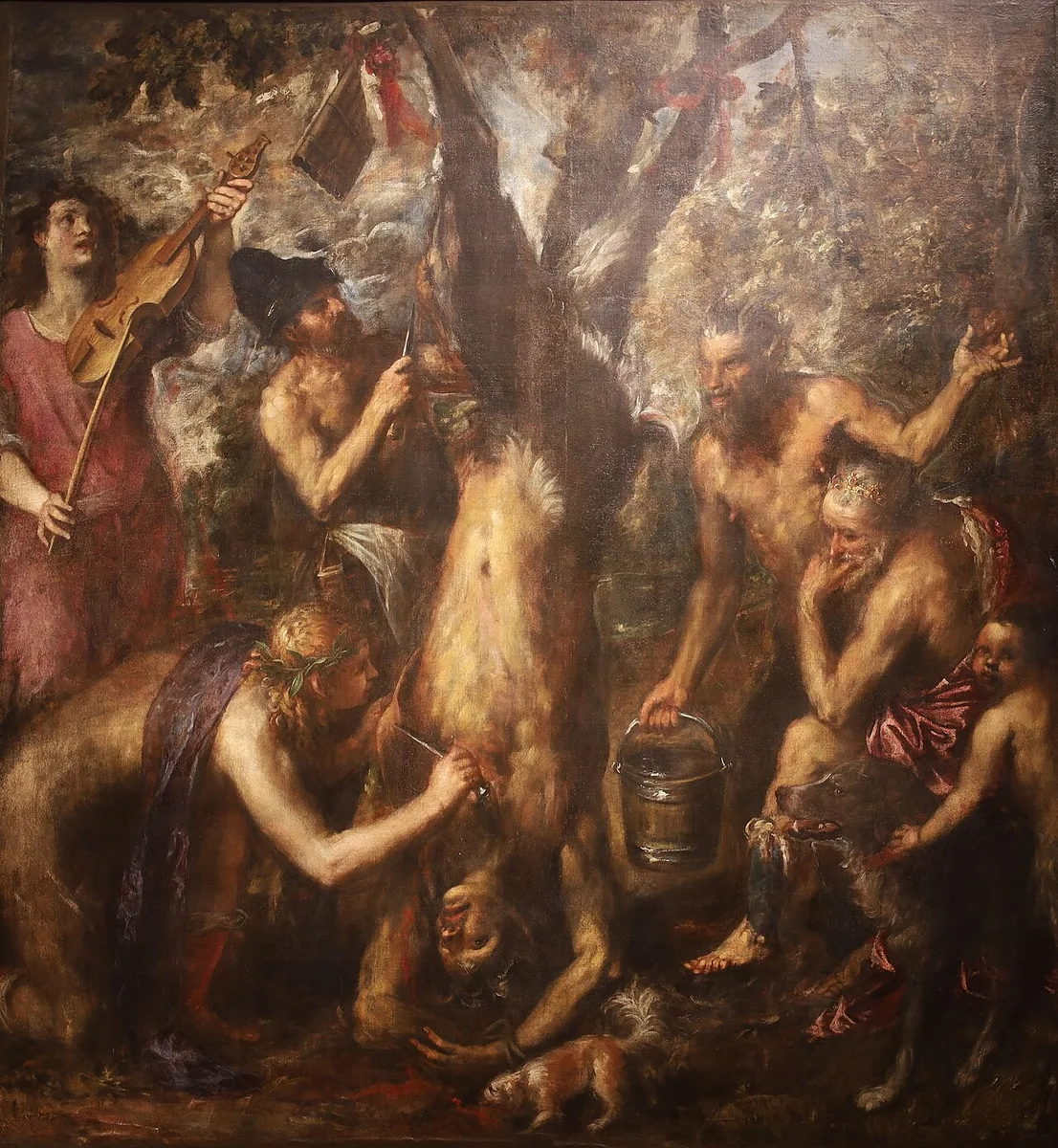
Flaying of Marsyas
Match for you
Rate 5 more paintings to see how well this one matches your taste.
Where to see it
Kroměříž Archdiocesan Museum
About the painting
The Flaying of Marsyas is a painting by the Italian late Renaissance artist Titian, probably painted between about 1570 and his death in 1576, when in his eighties. It is now in the Archbishop's Palace in Kroměříž, Czech Republic and belongs to the Archbishopric of Olomouc (administered by Olomouc Museum of Art – Archdiocesan Museum). It is one of Titian's last works, and may be unfinished, although there is a partial signature on the stone in the foreground.
Read more
The painting shows the killing by flaying or skinning alive of Marsyas, a satyr who rashly challenged the god Apollo to a musical contest. It is one of several canvases with mythological subjects from Ovid which Titian executed in his late years, mostly the poesie series for King Philip II of Spain, of which this painting seems not to have been part.
The painting has been in Kroměříž in Moravia since 1673, and was rather forgotten about, being off the beaten track as far as Venetian painting is concerned. It "did not enter critical literature until 1909". By the 1930s it was "widely accepted as an important late work" among scholars, but little known by a wider public.
On its first modern appearance abroad, it "was greeted with astonished admiration" as the "star attraction" of a major exhibition at the Royal Academy in London in 1983, It was new to most viewers and was described by John Russell in the New York Times as "the most astonishing picture in the show". Beginning an extended analysis, Sir Lawrence Gowing wrote that "All these months – it is not too much to say – London has been half under the spell of this masterpiece, in which the tragic sense that overtook Titian’s poesie in his seventies reached its cruel and solemn extreme. At most hours on most days there is a knot of visitors riveted and fairly perplexed in front of it. ... At the Academy people still ask, and on the radio well-meaning critics debate, how it is possible that a horribly painful subject should be the occasion of beauty or greatness in art."
Source: Wikipedia · CC BY-SA 4.0
Similar works

Image: Titian; Wikimedia Commons · public domain