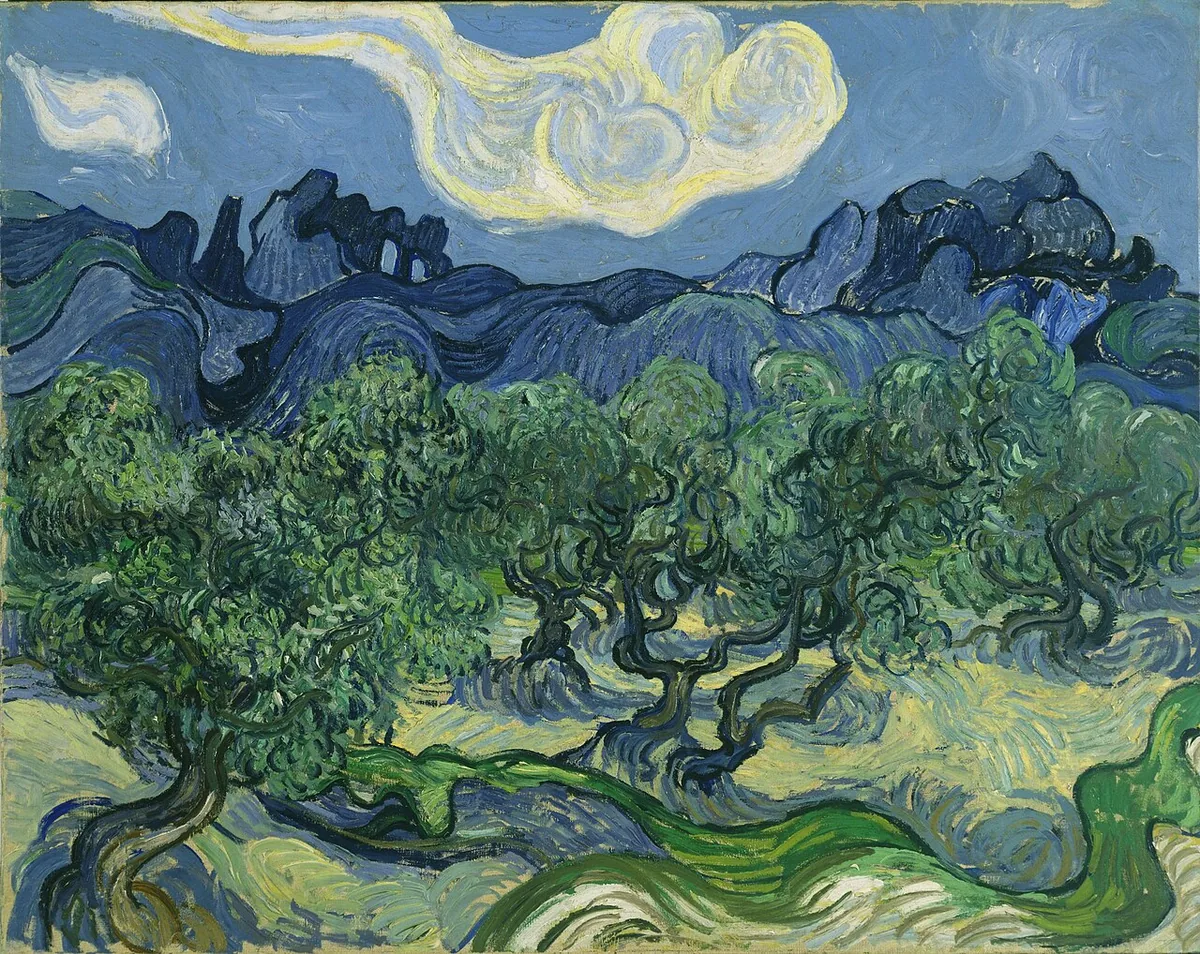
Olive Trees
Match for you
Rate 5 more paintings to see how well this one matches your taste.
Where to see it
Museum of Modern Art, New York City
About the painting
Vincent van Gogh produced at least 15 paintings of olive trees, mostly in Saint-Rémy-de-Provence in 1889. At his own request, he lived at an asylum there from May 1889 through May 1890, painting the gardens of the asylum and, when he had permission to venture outside its walls, nearby olive trees, cypresses and wheat fields.
Read more
Van Gogh was fascinated by olive trees, as their varied, ever-changing colors and irregular shape challenged him to experiment with new techniques and approaches. He painted at different times of the day and used colors inspired by the season. One painting, Olive Trees in a Mountainous Landscape, was a complement to The Starry Night.
The olive tree paintings had special significance for van Gogh. A group painted in May 1889 represented life, the divine and the cycle of life, while those from November 1889 arose out of his attempt to symbolize his feelings about Christ in Gethsemane. His paintings of olive pickers demonstrate the relationship between man and nature by depicting one of the cycles of life, harvesting or death; they also convey an example of how individuals, through communion with nature, can connect with the divine.
Van Gogh found respite and relief through interacting with nature. When the series of olive tree paintings was made in 1889, he was subject to illness and emotional turmoil, yet the paintings are considered to be among his finest works, and van Gogh himself held them in high regard.
Source: Wikipedia · CC BY-SA 4.0
Similar works

Image: Vincent van Gogh; Wikimedia Commons · public domain