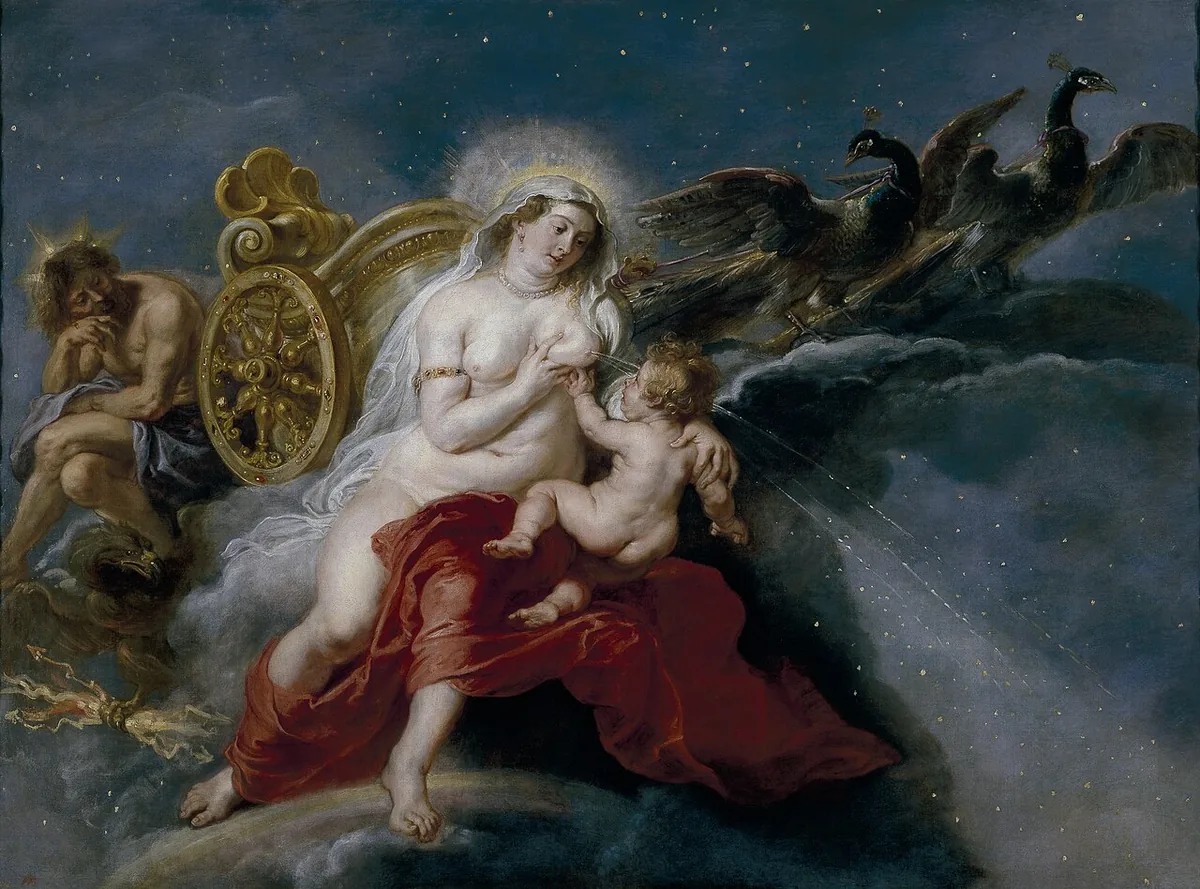
The Birth of the Milky Way
Match for you
Rate 5 more paintings to see how well this one matches your taste.
Where to see it
Museo del Prado, Madrid
About the painting
The Birth of the Milky Way, also sometimes known as The Origin of the Milky Way, is an oil-on-canvas painting by the Flemish artist Peter Paul Rubens, produced between 1636 and 1638 and featuring the Greco-Roman myth of the origin of the Milky Way. The painting depicts Hera (Juno), spilling her breast milk, the infant Heracles (Hercules) and Zeus (Jupiter) in the background, identifiable by his eagle and lightning bolts. Hera's face is modelled on Rubens' wife, Hélène Fourment. The carriage is pulled by peacocks, a bird which the ancient Greeks and Romans considered sacred to both themselves and to Hera/Juno, as a result of their ability to signal changes in weather through cries and hence their perceived connection to the gods.
Read more
With a width of 244 cm (96 in) and height of 181 cm (71 in), the image was a part of the commission from Philip IV of Spain for Rubens, along with other painters such as Diego Velázquez, to decorate Torre de la Parada, the monarch's recreational house and hunting lodge located on Monte de El Pardo. The commission consisted of 112 paintings based on Ovid's Metamorphoses, including this painting. The latter is now held in room 79 at the Museo del Prado, in Madrid, with inventory number P01668.
Source: Wikipedia · CC BY-SA 4.0
Similar works
Image: Peter Paul Rubens; Wikimedia Commons · public domain