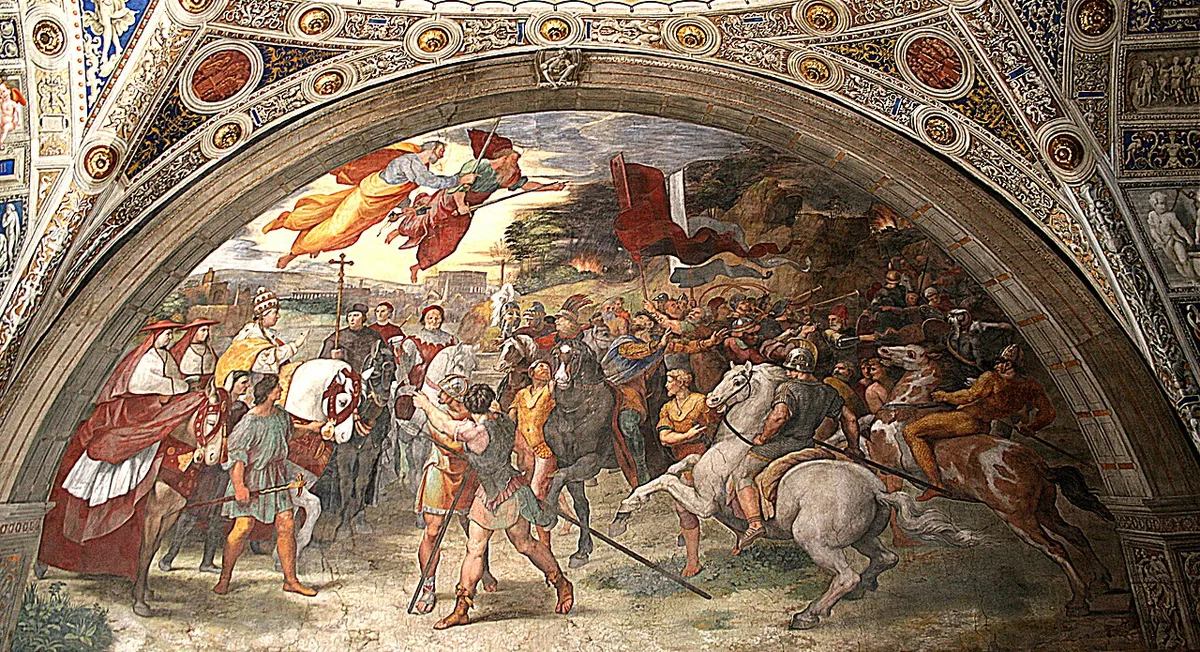
The Meeting of Leo the Great and Attila
Match for you
Rate 5 more paintings to see how well this one matches your taste.
Where to see it
Vatican Museums, Vatican City
About the painting
The Meeting of Leo I and Attila is a fresco through the Italian Renaissance artist Raphael. It was painted from 1513 to 1514 as part of Raphael's commission to decorate the rooms that are now known as the Stanze di Raffaello, in the Apostolic Palace in the Vatican. It is located in the Stanza di Eliodoro, which is named after The Expulsion of Heliodorus from the Temple.
Read more
The painting depicts the meeting between the Pope Leo I and Attila the Hun, which took place in 452 in northern Italy. Initially, Raphael depicted Leo I with the face of Pope Julius II but after Julius' death, Raphael changed the painting to resemble the new pope, Leo X. Leo X appears both as cardinal and as pope. The images of Saint Peter and Saint Paul appear in the sky bearing swords, and were said to have helped keep the king of the Huns from invading Italy.
The left half of the painting is mainly by Raphael, with only minimal work by his students. The result of this fresco exhibits great artistic skill, due to the usage of dark and light pigments which amplify the peaceful and the aggressive movements. It showcases a comparison of good and evil, which ties in the political and religious perspective of the Pope, who commissioned the work.
Source: Wikipedia · CC BY-SA 4.0
Similar works
Image: Raphael; Wikimedia Commons · public domain