The School of Athens
Match for you
Rate 5 more paintings to see how well this one matches your taste.
Where to see it
Vatican Museums, Vatican City
About the painting
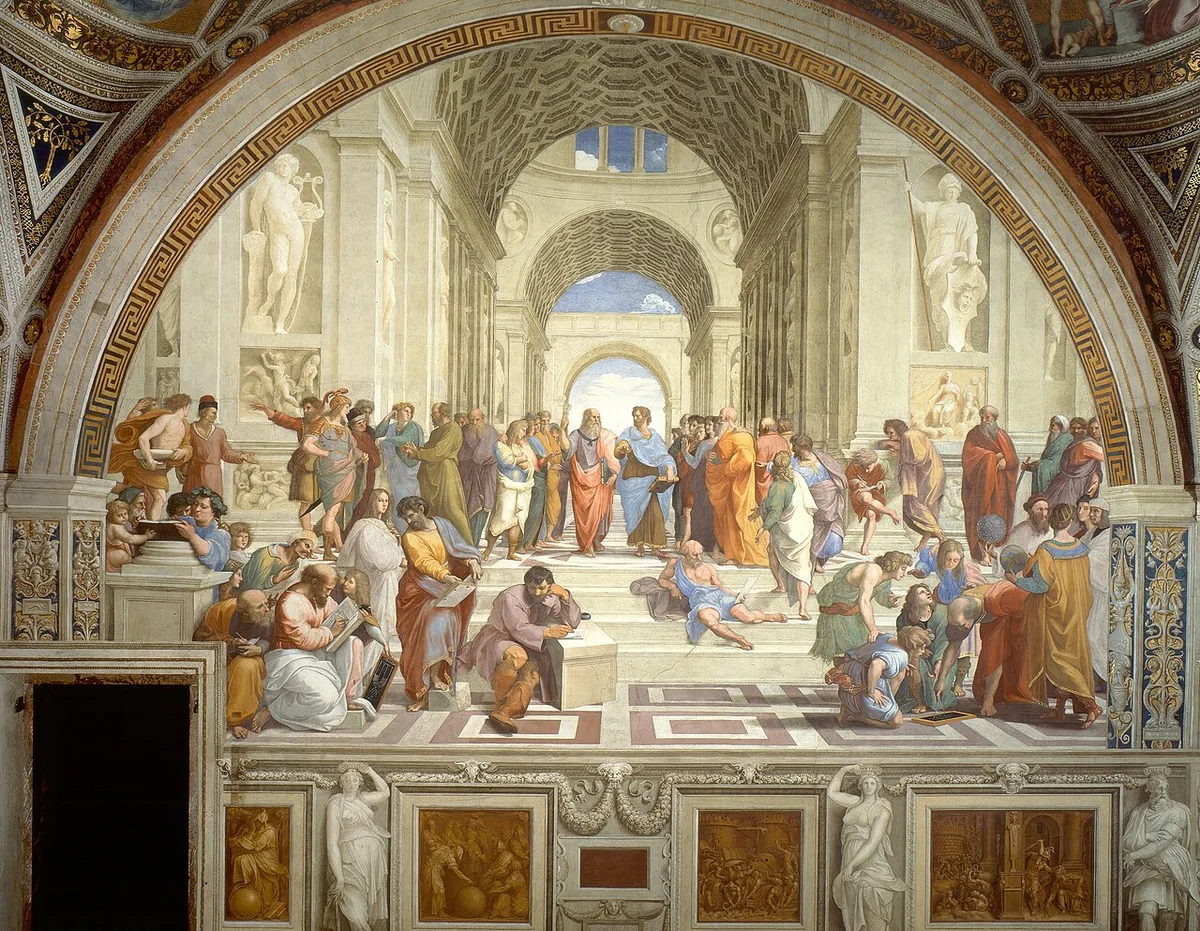
The School of Athens (Italian: Scuola di Atene) is a fresco by the Italian Renaissance artist Raphael. It was painted between 1509 and 1511 as part of a commission by Pope Julius II to decorate the rooms now called the Stanze di Raffaello in the Apostolic Palace in Vatican City.
Read more
The fresco depicts a congregation of ancient mathematicians, philosophers, and scientists, with Plato and Aristotle featured in the center. The identities of most figures are ambiguous or discernible only through subtle details or allusions; among those commonly identified are Socrates, Pythagoras, Archimedes, Heraclitus, Ibn Rushd (known as Averroes in the west), Euclid, and Zarathustra. Additionally, Italian artists Leonardo da Vinci and Michelangelo are believed to be portrayed through Plato and Heraclitus, respectively. Raphael included a self-portrait beside Ptolemy.
The identity of the figure in the white robe on the left side of the fresco remains unknown. Notably, the figure is the only one to gaze directly at the viewer. The figure is most commonly identified as either Hypatia or Francesco Maria I della Rovere, the nephew of Pope Julius II.
The painting is notable for its use of accurate perspective projection, a defining characteristic of Renaissance art, which Raphael learned from Leonardo; likewise, the themes of the painting, such as the rebirth of Ancient Greek philosophy and culture in Europe were inspired by Leonardo's individual pursuits in theatre, engineering, optics, geometry, physiology, anatomy, history, architecture and art.
The School of Athens is regarded as one of Raphael's best-known works and has been described as his "masterpiece and the perfect embodiment of the classical spirit of the Renaissance".
Source: Wikipedia · CC BY-SA 4.0
Similar works

Image: Raphael; Wikimedia Commons · public domain