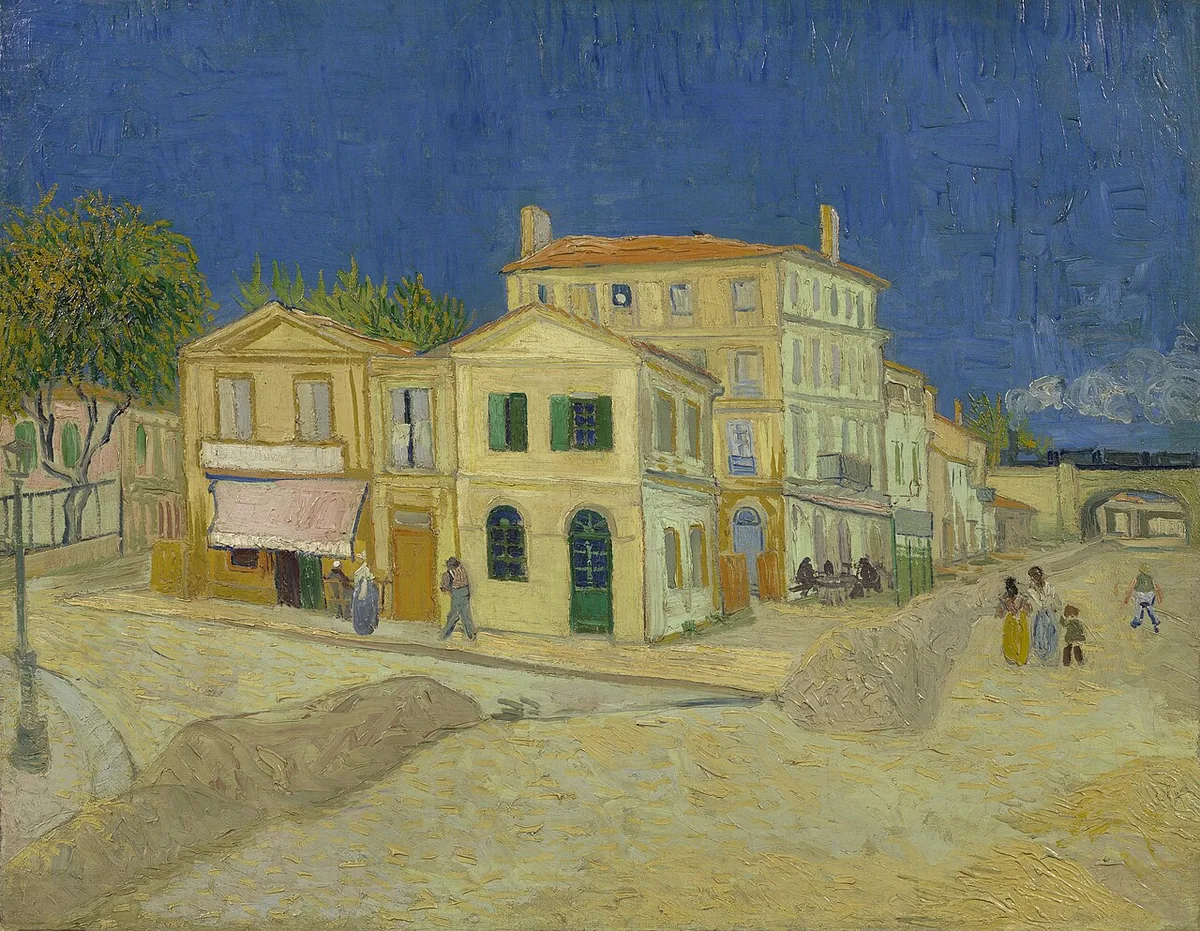
The Yellow House
Match for you
Rate 5 more paintings to see how well this one matches your taste.
Where to see it
Van Gogh Museum, Amsterdam
About the painting
The Yellow House (Dutch: Het gele huis), alternatively named The Street (Dutch: De straat), is an 1888 oil painting by the 19th-century Dutch Post-Impressionist painter Vincent van Gogh.
Read more
The house was the right wing of 2 Place Lamartine, Arles, France, where, on May 1, 1888, Van Gogh rented four rooms. He occupied two large ones on the ground floor to serve as an atelier (workshop) and kitchen, and on the first floor, two smaller ones facing Place Lamartine. The window on the first floor nearest the corner with both shutters open is that of Van Gogh's guest room, where Paul Gauguin lived for nine weeks from late October 1888. Behind the next window, with shutters nearly closed, is Van Gogh's bedroom. The two small rooms at the rear were rented by Van Gogh at a later time.
Van Gogh indicated that the restaurant where he used to have his meals was in the building painted pink, close to the left edge of the painting (28 Place Lamartine). It was run by Widow Venissac, who was also Van Gogh's landlady, and who owned several of the other buildings depicted.
To the right of the Yellow House, the Avenue Montmajour runs down to the two railway bridges. The first line (with a train just passing) served the local connection to Lunel, which is on the opposite (that is, right) bank of river Rhône. The other line was owned by the P.-L.-M. Railway Company (Paris Lyon Méditerranée).
In the left foreground is an indication of the corner of the pedestrian walk which surrounded one of the public gardens on Place Lamartine. The ditch running up Avenue Montmajour from the left towards the bridges served the gas pipe, which allowed van Gogh a little later to have gaslight installed in his atelier.
The building was severely damaged in a bombing raid by the Allies on June 25, 1944, and was later demolished.
Source: Wikipedia · CC BY-SA 4.0
Similar works
Image: Vincent van Gogh; Wikimedia Commons · public domain