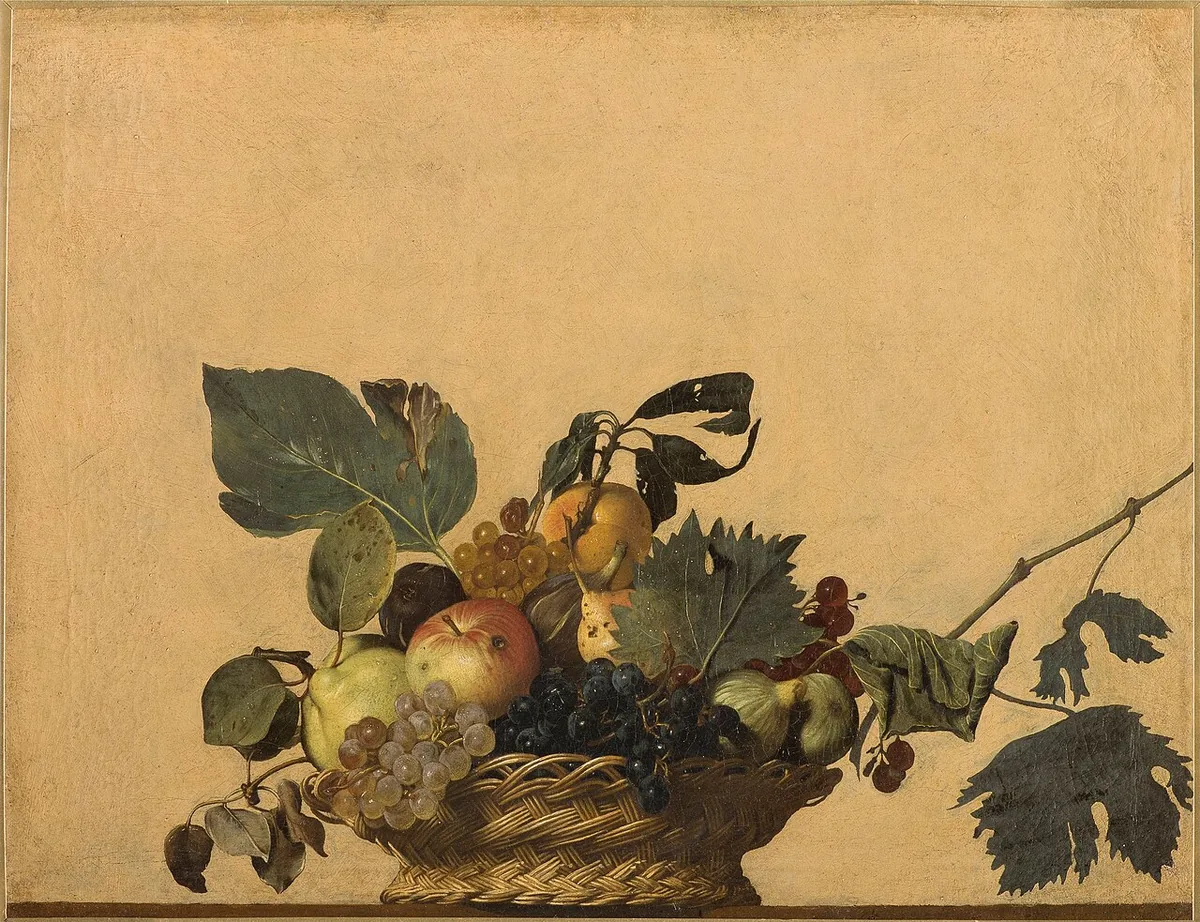
Basket of Fruit
Match for you
Rate 5 more paintings to see how well this one matches your taste.
Where to see it
Pinacoteca Ambrosiana, Milan
About the painting
Basket of Fruit (c.1599) is a still life painting by the Italian Baroque master Michelangelo Merisi da Caravaggio (1571–1610), which hangs in the Biblioteca Ambrosiana (Ambrosian Library), Milan.
Read more
It shows a wicker basket perched on the edge of a ledge. The basket contains a selection of summer fruit:
... a good-sized, light-red peach attached to a stem with wormholes in the leaf resembling damage by oriental fruit moth (Orthosia hibisci). Beneath it is a single bicolored apple, shown from a stem perspective with two insect entry holes, probably codling moth, one of which shows secondary rot at the edge; one blushed yellow pear with insect predations resembling damage by leaf roller (Archips argyospita); four figs, two white and two purple—the purple ones dead ripe and splitting along the sides, plus a large fig leaf with a prominent fungal scorch lesion resembling anthracnose (Glomerella cingulata); and a single unblemished quince with a leafy spur showing fungal spots. There are four clusters of grapes, black, red, golden, and white; the red cluster on the right shows several mummied fruit, while the two clusters on the left each show an overripe berry. There are two grape leaves, one severely desiccated and shriveled while the other contains spots and evidence of an egg mass. In the right part of the basket are two green figs and a ripe black one is nestled in the rear on the left. On the sides of the basket are two disembodied shoots: to the right is a grape shoot with two leaves, both showing severe insect predations resembling grasshopper feeding; to the left is a floating spur of quince or pear.
Much has been made of the worm-eaten, insect-predated, and generally less than perfect condition of the fruit. In line with the culture of the age, the general theme appears to revolve about the fading beauty, and the natural decaying of all things. Scholars also describe the basket of fruit as a metaphor of the Church.
A recent X-ray study revealed that it was painted on an already used canvas painted with grotesques in the style of Caravaggio's friend Prospero Orsi, who helped the artist in his first breakthrough into the circles of collectors such as his first patron, Cardinal Francesco Maria del Monte, around 1594/1595, and who remained close to him for many years thereafter.
Scholars have had more than their usual level of disagreement in assigning a date to the painting: John T. Spike places it in 1596; Catherine Puglisi believes that 1601 is more probable; and practically every year in between has been advanced. Puglisi's reasoning seem solid, (the basket in this painting seems identical with the one in the first of Caravaggio's two versions of Supper at Emmaus - even the quince seems to be the same piece of fruit), but no consensus has emerged.
Source: Wikipedia · CC BY-SA 4.0
Similar works

Image: Caravaggio; Wikimedia Commons · public domain