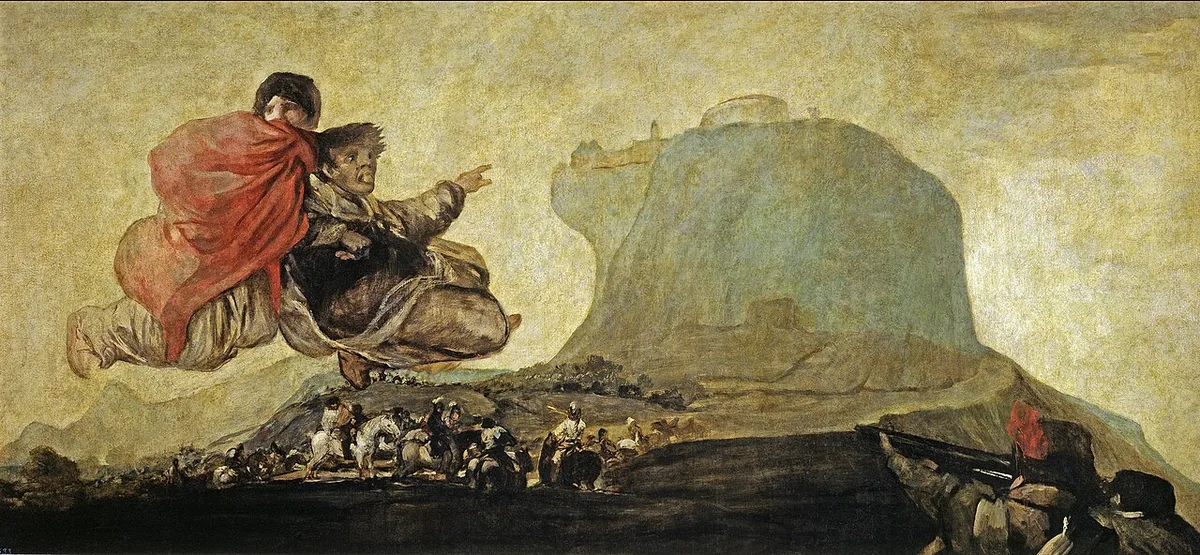
Asmodea
Sizinlə uyğunluq
Daha 5 rəsmi qiymətləndirin - bu əsərin zövqünüzə nə qədər uyğun olduğunu görəcəksiniz.
Harada baxmaq olar
Prado muzeyi, Madrid
Rəsm haqqında
Azərbaycan dilində təsvir hələ yoxdur - ingilis dilində göstəririk.
Asmodea or Fantastic Vision (Spanish: Visión fantástica) are names given to a fresco painting likely completed between 1820 and 1823 by the Spanish artist Francisco Goya. It shows two flying figures hovering over a landscape dominated by a large tabled mountain. Asmodea is one of Goya's 14 Black Paintings—his last major series—which, in mental and physical despair, he painted at the end of his life directly onto the walls of his house, the Quinta del Sordo, outside Madrid.
Tam oxu
No written or oral record survives as to the series' intended meaning, and it is probable that they were never intended to be seen by those outside his then small immediate circle. Goya did not name any of the works in the series; the title of Asmodea was later given by his friend, the Spanish painter Antonio Brugada. The title is likely a feminine naming of the demon king Asmodeus from the Book of Tobias. However, according to López Vásquez first and Moffitt later, the title relates to the myth of Greek Titan Prometheus, in which the goddess Athena carries him to the Caucasus Mountains.
Two figures, one male and one female, are shown airborne, hovering above a broad landscape. The woman wears a white dress covered by a red-rose coloured robe. Both seem fearful; she covers the lower half of her face with her robe, and his face is deeply disturbed. They are each looking in opposite directions while he points to a town on top of a mountain on the right of the canvas. Critic Evan Connell notes that the mountain's shape resembles Gibraltar, a refuge for Spanish liberals during the aftermath of the Peninsular War. In the foreground, a row of French soldiers, resembling those from Goya's 1814 The Third of May 1808, take aim at a group of people passing in the lower distance. This group is travelling with horses and wagons, and are perhaps refugees fleeing from the earlier war with France, the victims of whom Goya detailed in his The Disasters of War.
Writer Richard Cottrell has noted the similarity in the colouring of the 'livid' sky with another work from the Black Painting series, The Dog. The work bears similarity to Atropos and A Pilgrimage to San Isidro, in that it utilises an elliptical visual device to distort the viewer's perspective. In this case, the robe of the male flyer brings him almost out of the canvas and much closer to the viewer than the female flyer. Like Atropos, this work is one of the only from the series in which its intended meaning can be deduced from its classical sources.
Mənbə: Vikipediya · CC BY-SA 4.0
Oxşar əsərlər

Şəkil: Francisco Goya; Wikimedia Commons · ictimai mülkiyyət