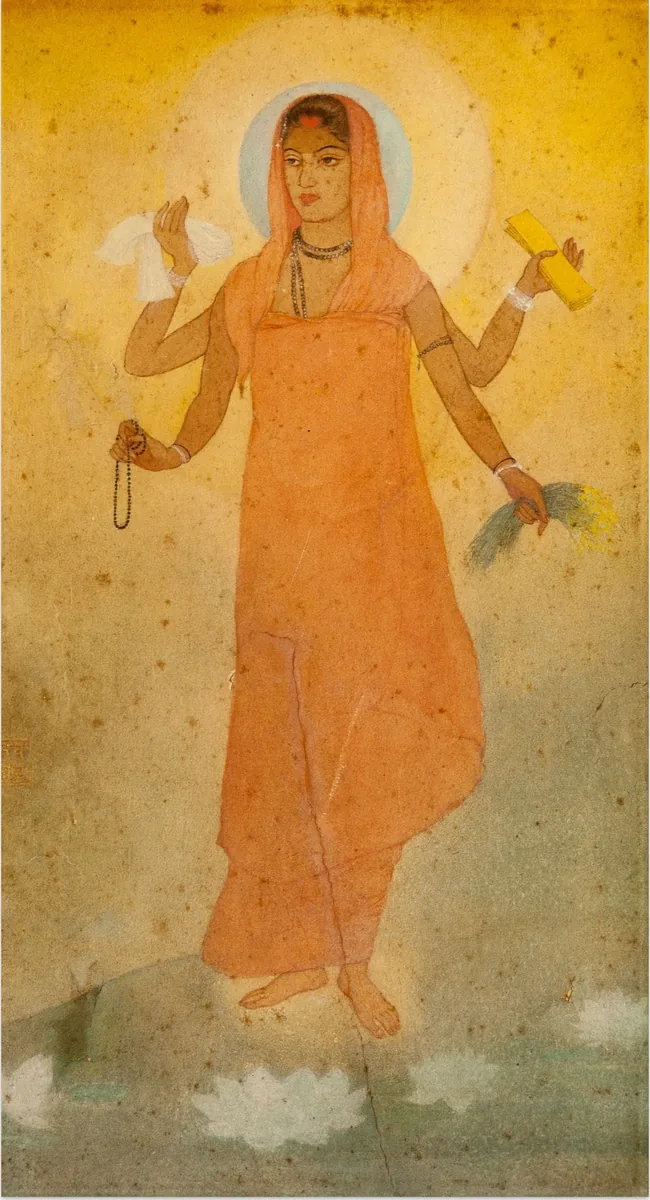
Bharat Mata
Совпадение с вами
Оцените ещё 5 картин - и увидите, насколько эта работа в вашем вкусе.
Где посмотреть
Мемориал Виктории, Калькутта
О картине
Описания на русском пока нет - показываем на английском.
Bharat Mata is a work painted by the Indian painter Abanindranath Tagore in 1905, originally titled Banga Mata (“Mother Bengal”) and later renamed Bharat Mata (“Mother India”). It is based on the personification of the nation as described by Bankim Chandra Chattopadhyay in his Anandamath. The artwork depicts a saffron-clad woman, dressed like a sadhvi, holding a book, sheaves of paddy, a piece of white cloth, and a rudraksha garland (mala) in her four hands. The painting was the first illustrated depiction of the concept and was painted with Swadesh ideals during the larger Indian Independence movement.
Читать полностью
A nephew of the Indian poet and artist Rabindranath Tagore, Abanindranath was exposed at an early age to the artistic inclinations of the Tagore family.
Tagore had been exposed to learning art when he first studied at the Sanskrit College in Kolkata in the 1880s. In his early years, Tagore had painted in the European naturalistic style, evident from his early paintings such as The Armoury. In about 1867 or 1887, Tagore's relative Gyanadanandini Devi had set up a meeting between Tagore and E.B Havell, who was the curator of the Government school of Art in Calcutta. The meeting resulted in a series of exchanges between Havell and Tagore, with Havell gaining a native art collaborator with ideas in the same direction of his own, and Tagore gaining a teacher who would teach him about the 'science' of Indian art history. He attempted to induct Tagore as the Vice Principal of the art school, which was faced with heavy opposition in the school. Havell had to bend much of the school rules to do this, and tolerated many of Tagore's habits including the smoking of hookah in the classrooms and refusing to stick to time schedules.
Источник: Википедия · CC BY-SA 4.0
Похожие работы
Изображение: Abanindranath Tagore; Wikimedia Commons · общественное достояние