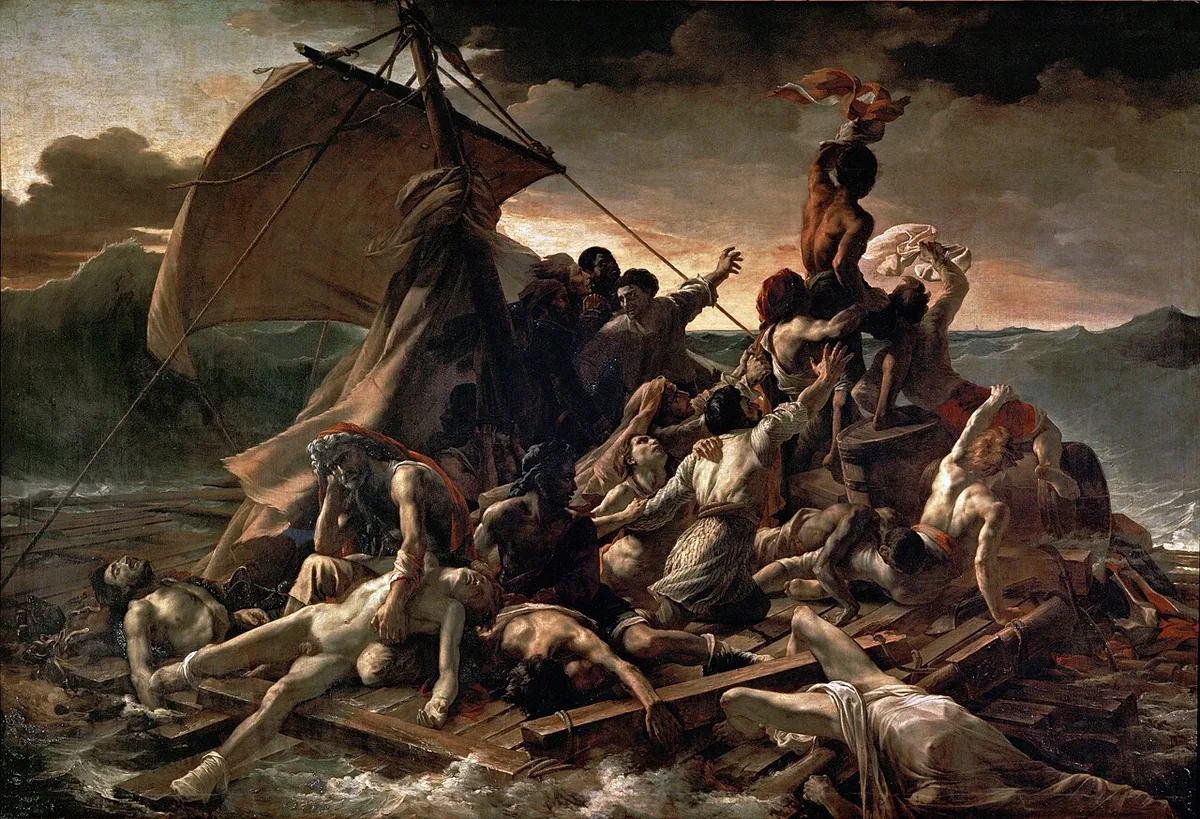
The Raft of the Medusa
Match for you
Rate 5 more paintings to see how well this one matches your taste.
Where to see it
Louvre Museum, Paris
About the painting
The Raft of the Medusa (French: Le Radeau de la Méduse [lə ʁado d(ə) la medyz])—originally titled Scène de Naufrage (Shipwreck Scene)—is an oil painting of 1818–1819 by the French Romantic painter and lithographer Théodore Géricault (1791–1824). Completed when the artist was 27, the work has become an icon of French Romanticism. At 491 by 716 cm (16 ft 1 in by 23 ft 6 in), it is an over-life-size painting that depicts a moment from the aftermath of the wreck of the French naval frigate Méduse, which ran aground off the coast of today's Mauritania on 2 July 1816. On 5 July 1816, at least 150 people were set adrift on a hurriedly constructed raft; all but 15 died in the 13 days before their rescue, and those who survived endured starvation and dehydration and practiced cannibalism. The event became an international scandal, in part because its cause was widely attributed to the incompetence of the French captain. Géricault chose this large-scale uncommissioned work to launch his career, using a subject that had already generated widespread public interest. The event fascinated him.
Read more
Théodore Géricault's social circles had close family connections with the French Navy and were directly involved in France's colonies and France's slave trade. Indeed, one of these relations, a naval officer and a slave owner, died defending France's colonial interests on the coast of west Africa in 1779 not far from the site of the Méduse shipwreck decades later.
Before Géricault began work on the final painting, he undertook extensive research and produced many preparatory sketches. He interviewed two of the survivors and constructed a detailed scale model of the raft. He visited hospitals and morgues where he could view, first-hand, the colour and texture of the flesh of the dying and dead. As he had anticipated, the painting proved highly controversial at its first appearance in the Salon of 1819, attracting passionate praise and condemnation in equal measure. However, it established his international reputation and today is widely seen as seminal in the early history of the Romantic movement in French painting.
Although The Raft of the Medusa retains elements of the traditions of history painting, in both its choice of subject matter and its dramatic presentation, it represents a break from the calm and order of the prevailing Neoclassical school. Géricault's work attracted wide attention from its first showing and was then exhibited in London. The Louvre acquired it soon after the artist's death at the age of 32. The painting's influence can be seen in the works of Eugène Delacroix, J. M. W. Turner, Gustave Courbet, and Édouard Manet.
Source: Wikipedia · CC BY-SA 4.0
Similar works








Image: Théodore Géricault; Wikimedia Commons · public domain